
Checkout mobile basati su RFID
10 agosto
In questa conversazione approfondiamo il caso di successo di Samsøe Samsøe e il ruolo di RFID nelle sue operazioni di supply chain.
Questo video non può essere riprodotto perché non hai ancora acconsentito ai cookie di marketing.
Benvenuto a questa conversazione sul percorso RFID di Samsøe Samsøe. Esamineremo i passi concreti, le lezioni apprese e il modo in cui RFID supporta le operazioni di negozio e la supply chain.
Partecipano alla conversazione Tommy, direttore finanziario di Samsøe Samsøe, e Simeon, responsabile IT. Tommy offre la prospettiva strategica e finanziaria; Simeon condivide quella tecnica e di implementazione.
Per iniziare, come descriveresti Samsøe Samsøe e il suo mercato?
Samsøe Samsøe is a Danish fashion brand with Scandinavian roots. We operate in the premium segment and design for both women and men. That connection to Danish and Scandinavian culture remains central to the brand.
Non capita tutti i giorni che un direttore finanziario sia così coinvolto in RFID. Perché è un tema importante per te?
I joined the company nearly 20 years ago, when it was much smaller. Technology naturally landed on my desk alongside finance. I enjoy optimisation, and for finance, optimisation is often straightforward: it saves money and adds value. That lets me assess the return on investment and see how a project can contribute to the company.
I have been with Samsøe Samsøe for almost four years. Working directly with the CFO makes change easier because we can connect technology decisions to the business immediately. We have been on a digital journey together throughout that time.
Da quanto tempo RFID fa parte del vostro percorso?
I first looked into RFID around 10 to 15 years ago. The technology was still expensive, so the business case was not ready. We considered a full integration for another brand at an early stage, but it was simply too soon. I kept following the technology until it matured and the return on investment became compelling.
I have worked in supply chain and IT for more than 14 years, and with RFID since 2013. At that time, a label could cost close to a euro, so a retail business case was difficult to defend. Costs have changed dramatically. RFID has also evolved from visibility and stock accuracy into applications such as in-store traceability, camera-supported theft detection and digital product passports.
Like many technologies, RFID needed time to mature. As the technology became more established, it became more affordable and practical to implement.
Qual è stata la motivazione iniziale per adottare RFID?
Omnichannel retail was the first driver. We had stores with stock, but we needed to make that stock available online. Connecting systems is the easy answer, but it only works when store inventory is accurate. Accurate stock at any point in time was the key reason to start the RFID journey in 2016.
RFID also gives time back to store colleagues. Instead of spending long periods on manual stock takes, they can spend more time with customers and on the sales floor. A typical stock take can be completed in about 20 to 25 minutes, and that time can be reinvested in the customer experience.
Dopo anni di utilizzo di RFID nei negozi, quali obiettivi restano da raggiungere?
The ambition list was long from the start, but not every idea can be funded at once. We began with the simplest use case: stock taking. Moving from four annual stock takes to 52 created a strong foundation. It required hardware, labelling and process changes, but it showed what was possible beyond a single KPI: more time on the shop floor and more reliable inventory data.
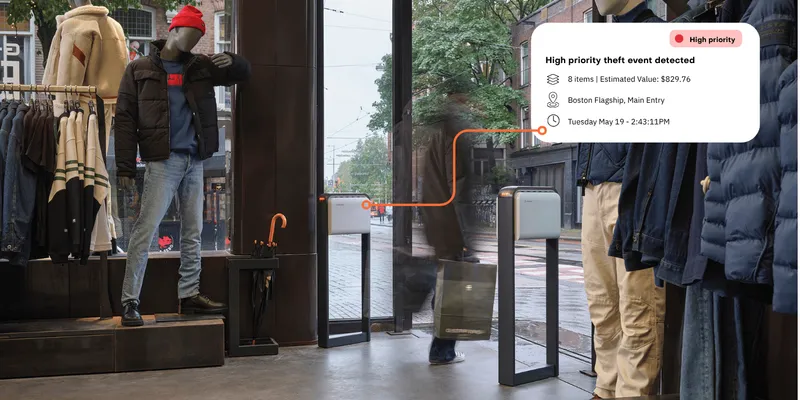
Theft is another important topic in fashion. We have been exploring how RFID, self-checkout and camera technology can work together. The market is moving towards more standard, partner-enabled solutions, instead of every retailer needing to build a large custom project.
Our vision is for stores to be smarter and more connected. Retailers use many vendors, and those systems do not always integrate easily. In several stores, we connected an RFID plate with the POS solution. It gives the store a cleaner setup: colleagues can place garments on the plate instead of scanning every item individually with a handheld device.
We are also looking at camera integration. Combined with iD Cloud at the gates, this can support more connected and secure stores. The value is not just efficiency. It helps colleagues work more easily and creates a better store experience for customers.
È un punto importante: i vantaggi non si riflettono sempre in un unico indicatore finanziario. Anche far risparmiare tempo ai colleghi e migliorare l'esperienza del cliente può avere un impatto significativo.
Quando l'attenzione si è spostata dai negozi alla supply chain?
Once we wanted to optimise store flows, we had to ask how items could be scanned when they arrived. Our first experiments involved a tunnel. At the time, Nedap did not yet provide the supply-chain capabilities we needed, so we worked with other vendors and built an integration ourselves with a member of our team.
The pilot delivered useful insights, but it also exposed limitations. The conveyor and tunnel could slow the process down, and a custom integration becomes fragile when the people who built it are unavailable. We saw the opportunities in inbound, outbound and other supply-chain movements, but scaling a full conveyor-and-tunnel setup was too expensive for a company of our size.
We paused that work around 2018 and 2019, and many supply-chain initiatives stopped during COVID. The local innovation in stores continued, but we waited until the timing and technology were right.
In 2021 we upgraded our ERP system. That meant changing integrations, which is always a risk. Rather than rebuild a lightly documented custom integration, we looked for a more robust approach. We knew Nedap was developing supply-chain capabilities through Harmony, and we were keen to see when it would be ready.
Quali soluzioni utilizzate oggi in magazzino?
We started with the low-hanging fruit: returns. A full-scale supply-chain solution was not the right first step, so we looked for an area with high impact and a relatively simple setup. On returns, RFID allows us to scan many items quickly instead of opening a box and checking every barcode one by one.
The project began with a joint workshop involving the Samsøe Samsøe team, Nedap and our warehouse-management partner. In the B2C returns area, the setup is deliberately simple: an RFID printer for replacement labels, an iPad with Harmony as a web application, and a full-size RFID plate underneath the table.
We use a similar setup for wholesale returns. When a box comes back, we can scan its contents and verify that the return is complete without opening it and manually counting every item. Connecting the hardware, infrastructure and Harmony took about two days; close collaboration with the development team helped resolve the practical details quickly.
The result has been well received by the warehouse team. It significantly improves the inbound flow for returned goods. We estimate that the process is at least five or six times faster in many cases, while the investment remains modest: a plate, an iPad, a scanner and the required integration.
Il tavolo per i resi migliora chiaramente la velocità. Ci sono altri vantaggi?
Traceability is a major one. With the serialised RFID tag, we can follow an item from the warehouse to a store and back again. If an item leaves a store without being scanned and later appears in returns, iD Cloud gives us the information to investigate its journey.
This also helps with grey-market situations. When we sell stock to an outlet outside Europe, we do not expect it to return through other channels. RFID lets us record what was sold, which batch and order it belonged to, and when it was shipped. If an item reappears, we can scan it and establish where it came from.
In the past, it was difficult to demonstrate the origin of a specific garment when many items shared the same style and colour. With a serialised tag, that evidence is much clearer. It is a simple use case, but an important one when a retailer needs to take action.
The return solution therefore combines process efficiency with traceability. It can help confirm whether an item is legitimate, whether it has been stolen, and whether it should be in a particular returns flow.
Qual è il prossimo passo in magazzino?
The next practical use case is e-commerce and B2C order verification. We pick multiple orders in one wagon, often up to 16 orders at a time. Tags are scanned during picking, but items can still be placed in the wrong bin or dropped during the process.
A smaller RFID plate at the packing table can verify that each order contains the correct items before it leaves the warehouse. It uses the same principle as the returns solution, but supports outbound accuracy and reduces the risk of incorrect deliveries and unnecessary returns.
It is another example of starting small. The use case is clear, the investment is relatively contained, and it can be scaled over time into larger outbound scanning operations when the underlying integrations are ready.
Our current environment combines warehouse management and ERP in Microsoft Business Central. As integrations grew, we began to encounter database locks and concurrency issues. We realised that we need to separate ERP and warehouse management before scaling more RFID processes.
The lesson is that integration is often more important than the hardware. The original ideas are still possible, but they need to fit a sustainable system architecture. Every major system change affects integrations, so the goal is to simplify the landscape and use best-of-breed technology that can scale properly.
That is why native integration with Nedap is an important selection criterion for our future warehouse-management system. We do not want to keep building and maintaining custom integrations ourselves. A standard integration provides a stronger foundation for both Samsøe Samsøe and other retailers that want to follow a similar path.
Dove vedete le maggiori opportunità per il futuro?
The long-term goal is complete insight: inbound, outbound and every important movement. The immediate priority is B2C outbound scanning from the warehouse. Stores already use RFID, but e-commerce orders packed in the warehouse need the same level of certainty.
The B2C packing-table use case connects the product identifier to the order and customer. Once it works reliably at the table, the same integration can be expanded from individual items to boxes and larger flows. It is not a different concept; it is a scale-up of a proven process.
Inbound scanning remains attractive too. In earlier supply-chain projects, RFID revealed occasional discrepancies between quantities shipped and quantities received. At the time, deviations could be several percent. Today, outbound scanning at suppliers and a shared view of the data can make those discussions far more transparent.
The ideal is a clear agreement with suppliers: both parties know what was shipped and received, and deviations can be resolved based on data. For wholesale outbound, it also lets us prove that a shipment left the warehouse with the right number of boxes and items, which is valuable when investigating chargebacks or transport issues.
More scans improve the value of the data. If a supplier produces more RFID tags than are commissioned for shipped products, uncommissioned tags can be recognised when they appear elsewhere. That adds another layer of protection against illegitimate goods and supports a stronger, more connected supply chain.
Una domanda del pubblico riguardava il ritorno sull'investimento e i KPI del magazzino e del processo dei resi. Che cosa misurate?
The central metric is optimisation: how much time do we save, and what does that mean for the business? Labour is a significant cost in a Danish warehouse, so reducing manual handling makes a clear difference. The return plate was adopted quickly because the team saw the benefit immediately: no more opening a box with many items and checking each one by hand.
We also consider benefits that are harder to express in one number, including better flow, less friction for colleagues, fewer errors, traceability and fraud reduction. The process needs to make sense operationally as well as financially.
Un'altra domanda riguardava l'integrazione dei dati di Harmony, dei dati RFID e delle informazioni EPC nell'insieme dei sistemi aziendali.
Our principle is that iD Cloud is the source of truth for RFID and physical inventory data. It is where we keep the reliable count and the EPC information. An ERP system is not always the right place to store every EPC record, particularly when the architecture is not designed for that scale.
At present, the integration into ERP is intentionally lightweight. After daily B2B and B2C scanning, an automated file is generated and imported into the ERP system. We could make this more sophisticated, but we prefer to focus future development on the new warehouse-management system and a scalable standard integration.
The key is to place each kind of data in the system that is designed to handle it. That keeps the solution practical today and leaves room to scale the RFID journey tomorrow.
Grazie a Tommy e Simeon e a tutti coloro che hanno partecipato e fatto domande. Per approfondire, leggi il caso di successo o contatta il team. Condividere esperienze concrete aiuta l'intero settore retail a progredire.
In Nedap aiutiamo i retailer globali ad adottare ed estendere RFID con successo, offrendo accuratezza delle scorte in tempo reale, migliorando la disponibilità dei prodotti sui diversi canali e supportando operazioni più intelligenti. Aiutiamo così i brand a migliorare i propri processi, in qualsiasi fase del loro percorso.