
Nedap introduces AI update that helps retailers prioritize high-impact crime incidents
May 19


 Ilse Protsman
In the current age of fashion retail, delivering a great shopping experience is crucial. One of the most important boxes to tick is to have the product available as soon as consumers are ready to buy. This is the main reason why most brands and retailers are looking into ways to manage their inventories efficiently.
Many leading brands and retailers around the globe are adopting RFID technology. But, in the meantime, many hesitators wonder what they get from it. How about you? Are you currently questioning whether you should invest in RFID?
Specifically now, in times of uncertainty, retailers have to prioritize. As a result, the list of projects and tasks to finish is long. Is one of the reasons why your organization has not implemented RFID yet one of the below?
You are certainly not the only one. Let's discuss what is currently happening in the market, and how RFID relates to that.
If you want to skip to the step-by-step guide immediately, start at chapter 5: "Step-by-step guide starting with RFID", in the menu on the side of this page.
The start of this decennium was marked by the pandemic, and pushed online shopping adoption ahead by around four to five years. Retailers bet on reinventing the in-store experience and reacted by widely adopting omnichannel services.
In the context of global uncertainty that we are still facing today, retailers realize that it is necessary to improve stock file accuracy since every piece of merchandise counts when leaner inventories are the rule of the day. Clear visibility of what is in stores and the supply chain is a fundamental foundation to ensure merchandise availability - physically (in-store) and digitally (online).
With the rise of the ‘zero consumer’, as defined by McKinsey, consumers are increasingly shopping across channels, showing little loyalty, and expecting fast shipping and sustainable products. You don't need to be a rocket scientist to realize it's vital to always avoid bad shopping experiences to remain successful. In today's highly competitive landscape, where retailers are fighting for the wallet of hyper-demanding consumers, inventory accuracy as a foundation for guaranteed product availability across all channels is a must to deliver the omnichannel shopping experience we all crave.
Radio Frequency Identification (RFID) technology offers a powerful solution to this challenge. However, to extract the maximum benefits from this technology, the first step for many retailers is to run an RFID pilot. The roadmap to successful implementation involves strategic planning, stakeholder engagement, iterative learning, and a rapid scale-up plan.
RFID can get complex quickly. So it's essential to start small, take a pragmatic approach, and scale smart on this over time. Once you have the basics of an accurate stock file as a foundation in your business, you can map out the RFID roadmap and phases.
Implementing RFID is a strategic choice that allows you to leverage other investments to provide further insights.
“More accurate inventory tracking can drive sales growth by providing associates and customers the ability to find every piece of merchandise down to the last unit available.”
Dick Johnson
CEO of Foot Locker
Typically, retailers may perform an audit on their stock once or twice a year. However, starting on the very first day after the audit, the accuracy of the stock file declines up to the next audit date. The internal teams are already available to explore RFID further within a retailer, as these tasks are already being performed regularly.
Starting with a basic, simplistic, and focused approach, a retailer can deploy RFID with a lightweight team led by a project manager. With the support of the right RFID partner, a business case can be built that then lays down the blueprint for the future direction.
Retailers considering whether RFID suits their business have decided based on a focused business case comparing invested capital against the benefits of selected use cases. What does improved stock file accuracy look like when exploring RFID?
Better accuracy leads to better product availability, which leads to increased sales. Sales increases are delivered because retailers have a much better size range available across all represented styles. Based on various proof of concepts with global retailers, we can see the following trends concerning accuracy and sales uplift in the table below.
Even a small improvement in inventory accuracy can create compounding value: more products available to sell, fewer cancellations, and greater confidence in omnichannel promises. Use a baseline to compare today’s accuracy with the result after the RFID pilot.
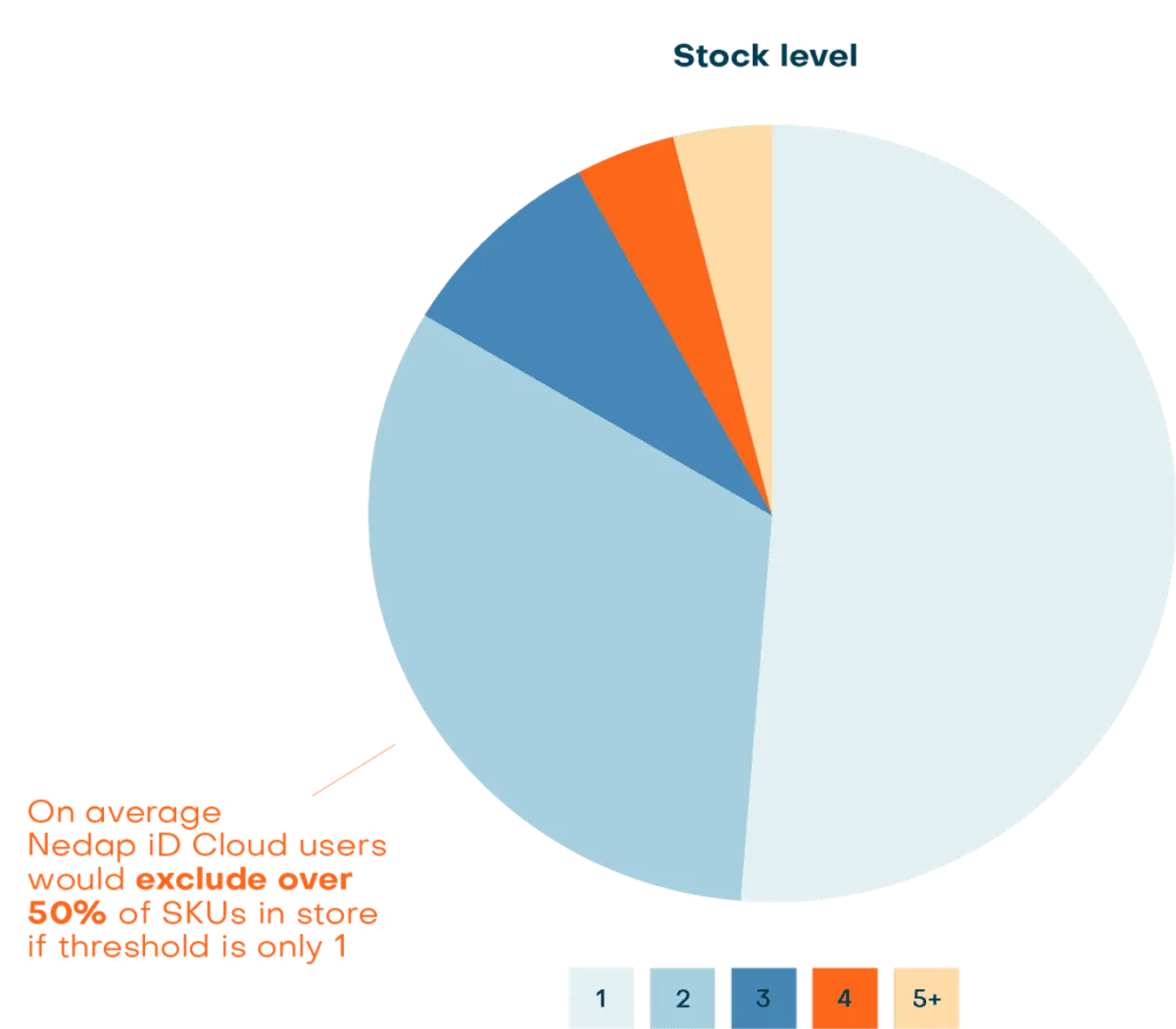
Maintaining stock accuracy is a real challenge for retailers not using RFID. Inaccuracies accumulate from theft, faulty deliveries to and from the DC, processual mistakes, and incorrect labeling. Retailers who don't have RFID typically have the worst stock accuracy when they most need it (peak trading). This is often immediately amended after the audit in the new year and when consumer spending often drops off.
If we look at never-out-of-stock items, they have a much more significant impact on sales when they are replenished more frequently using RFID. Retailers using RFID through peak trading can quickly adjust discrepancies, providing customers with a complete product offering at the most critical times.
The cost of inaccurate stock data accumulates over time, increasing stockouts and order cancellations. Ultimately, this leads to missed sales, but more importantly, it can also cause disappointed customers.
Retailers who use RFID for their stock management report that a 3-4% increase in stock file accuracy correlates to a 1% increase in sales. If you couple this up with retailers not using RFID during peak trading, these accuracy differences cost even more in lost sales potential.
RFID is the enabler for omnichannel services. Better stock visibility is the foundation for rolling out omnichannel services, such as Click & Collect (BOPIS), Click & Reserve (BORIS), or Ship-from-Store.
Recently, we can see a direct relationship between the adoption of RFID and how retailers see the technology impacting their omnichannel strategies. Not implementing RFID would mean that retailers miss out on the following:
“RFID is going to be a critical enabler in order for us to create a fully connected marketplace for NIKE products across both our own stores and our strategic partners”
Matthew Friend
Executive Vice President and Chief Financial Officer at Nike
Eventually, one can also use RFID upstream. The obvious one is the benefits in the DC as the RFID labels allow you to do efficient in and outbound scans of your goods. For example, tracking goods to wholesale partners or franchisers ensures these are not traded via grey market channels.
In short, you can trace back an EPC you find in an unapproved location. But even better, you can go upstream more and have your manufacturers make direct shipments to your wholesale channel. This cuts out the logistic costs of having them in your DC first.
Also, customers benefit from broader supply chain data, such as checking a product's provenance. For example, they can pick up a product and check its sourcing, authenticity, materials, and its entire lifecycle based on RFID tracking data.
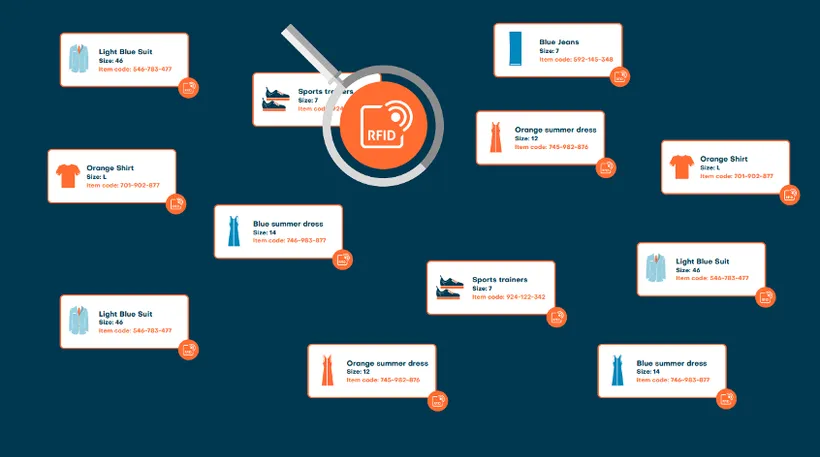
RFID allows retailers to have complete visibility of their supply chain and shows in detail which products are available in which stores. So they can ensure all sizes are represented on the sales floor for their customers to purchase.
So, long story short: without RFID, retailers will continue to work with inaccurate stock files. The "price of an inaccuracy" is manifold. However, these are only the starting losses for not using RFID. As the technology becomes embedded into an organization, further operational gains can be opened quickly, whether through the supply chain or by providing more services with confidence to the customer. So, ready to start? Here's how to make your RFID journey effective and beneficial:
Use these three phases to move from a focused business case to a repeatable rollout.

Start small
Build a focused business case, choose one measurable use case, and involve the people who own the process.
Test, learn, and adjust
Validate the approach in a small group of stores, review exceptions with users, and refine the process before rollout.

Scale with confidence
Turn the proven pilot into a rollout plan, align stakeholders, and prepare store teams to adopt the new way of working.
Embarking on your RFID journey does not necessarily mean an immediate, sweeping overhaul of your current systems. Instead, start small by holding a workshop with your stakeholders and experts from your selected RFID solution provider. These sessions should focus on creating a business case for RFID implementation tailored to your needs and challenges. Examples can include sales uplift, inventory accuracy, and shrink management. It is essential to use recent retail experiences as the foundation for this business case and to benchmark it against results from similar retailers. Another key takeaway is to strip away complexity and focus on only a few use cases. It’s far more satisfying to scale up based on success than to continuously have to prove the value of your RFID investment.
With a business case in place, it's time to validate it. To start, you can do this by selecting a small group of stores that have RFID-tagged merchandise or plan to tag merchandise in those stores. The products can be tagged at the distribution center (DC) or at the store itself, depending on what best suits your operations. This testing phase is your pre-rollout, executed step by step to ensure everything functions as expected.
Remember, it's crucial to have an iterative approach during this stage. Regularly gather data, evaluate the performance, and make necessary adjustments. This flexibility will allow you to fine-tune your RFID solution, ensuring it delivers the maximum benefits for your business.
Once your initial first stores have proven successful, it's time to scale up quickly. Following your pre-established rollout plan, you can implement the validated RFID technology across all your stores. It's also an opportunity to add new features and capabilities as needed. Depending on the use cases you are looking to achieve, you can extend beyond the basic functionalities, such as counting and refilling store inventory, to receiving shipments or assigning statuses to particular items.
Another important step is to involve the right stakeholders while amplifying your RFID journey. As we enter a new retail era, we see a shift in priorities with a clear focus on omnichannel services and correlated tools and capabilities such as stock visibility, order management, and mobile applications. Yet, retail organizations realize that they need more cross-functional collaboration, as:
In our experience with various retailers, we have seen several different scenarios – breaking the typical silos, as stated earlier. Here are some examples of the areas where stakeholders are coming from:
Successful RFID projects typically have one thing in common: they are embraced by the users, from top management to store associates. Therefore, make sure to train your team adequately and ensure they understand the benefits of RFID and how it operates. Their support and active participation can be the deciding factor in your project's success.
One of the primary reasons brands implement RFID is to maximize the customer experience by achieving complete stock visibility. RFID allows you to achieve accurate inventory levels across all channels, preventing stock-outs and enhancing the customer shopping experience. Always remember this ultimate goal as you continue to adopt RFID within your organization.
As we wrap up, let's revisit the exciting promise of Radio Frequency Identification (RFID) technology in the fast-paced world of retail, especially in the age of the 'zero consumer.' These consumers are discerning, quick to shift their loyalties, and expect nothing less than stellar service.
Your retail strategy should begin on a small scale with a well-crafted business case for RFID. Next, embark on a testing phase with an open mind, ready to learn and make necessary adjustments. Once you've validated the benefits, don't hold back—it's time to scale up.
But remember, this isn't a solo journey. Stakeholders from various departments should be on board, understanding the vast benefits RFID offers. Training your store teams to adopt RFID and understand its utility will prove instrumental to the success of this initiative.
Ultimately, everything circles back to improving the customer experience. With ultimate stock visibility and efficient inventory management, RFID technology allows you to cater to the demands of the 'zero consumer' in real-time. The end goal is a smooth, satisfying shopping experience for every customer, every time.
At Nedap, we help global retailers successfully adopt and scale RFID by enabling real-time stock accuracy, improving product availability across channels, and supporting smarter operations — empowering brands to enhance their processes, wherever they are in their journey.

May 19