
Nedap introduces AI update that helps retailers prioritize high-impact crime incidents
May 19


 Ilse Protsman
It is a common understanding that product availability is key in retail stores. To ensure perfect availability, a significant number of fashion and apparel retailers have already deployed RFID technology or are considering doing so. However, most of these solutions only solve a part of the product availability challenge – the DC-to-store replenishment. That means that the product is now guaranteed to be in the right store, but it is not necessarily on the sales floor and easily accessible for customers to buy. Such an item is commonly called a NOSBOS item – an item that is “not-on-shelf-but-on-stock”.
In this long read, we will briefly describe existing methods for replenishing missing items (and reducing NOSBOS), and then discuss three more sophisticated methods to ensure that stock is not sitting in the back of the house but is actually out on the sales floor.
With the first method, a store employee goes around the store with a piece of paper and a pen, writing down which product sizes are missing on the sales floor, and then gets them from the stock room.
The second method is based on sales transactions. At regular intervals, a list with all POS transactions is printed, and the sold items can be refilled from the stockroom. However, both methods are very time-consuming and flawed. The first method requires that store employees be very accurate in identifying which sizes are not on the sales floor or are no longer there, which is quite a daunting task even for the most experienced and disciplined. Moreover, when the list is finally complete, there is no guarantee that the missing size is actually available in the stockroom. The item might be out of stock, which makes the entire refill process inefficient and likely not very satisfying for the store staff.
The second method based on POS transactions does not take into account any refills that have happened throughout the day (e.g., when an item was already refilled from the stock room manually), and items that leave the store in any other way than via the POS (e.g., stolen items) will never get refilled. Just like the first method, this method also does not take into account items that are out of stock in the stock room, leading to inefficiencies as store associates search for missing items. Because of these flaws and new technological developments, these traditional methods are increasingly being substituted by more sophisticated refill methods. But what are the pros and cons of these new methods?
Using RFID, it is possible to differentiate between stock on the sales floor and stock in the stock room. Based on the RFID count for each sub-location, retailers can easily compile a complete list and start refilling. Unfortunately, the reality is a lot more complicated. Why is that? Basically, there can be multiple reasons why an item is not or should not be displayed on the sales floor, such as:
Therefore, this ‘naïve’ approach, where you simply state that any product that comes up from the RFID count as being present in the stock room and missing on the sales floor should be refilled, is also flawed. After each RFID count, you would get a long list of irrelevant results... week after week after week. This also makes the refill method very inefficient, because store employees need to spend a lot of time figuring out which results on the list are relevant and which are not.
To work around the above-described issue, retailers may use a planogram that assigns each item a pre-assigned position on a specific shelf. All store associates have to do then is to take the planogram and refill the missing spots. What sounds logical at first is quite a challenge.
The biggest challenge is that a planogram by definition will differ from store to store. Larger stores will carry more varieties than smaller stores, and even within those categories, there might be variations. Different countries will carry different products and display different sizes to cater to variations in customer sizes.
To make matters worse, this will differ over time: from week to week, or even day to day – based on the weather. Even if you were able to specify a planogram for each store, it would become obsolete over time because fashion is time-dependent.
To summarize, maintaining a planogram this flexible is extremely challenging. The effort required to maintain a decent planogram that works across a variety of stores outweighs the benefits of using it for a refill.
The subfield of algorithms and machine learning has gained increasing popularity in the past couple of years. The foremost reason is that machine learning is incredibly powerful at making predictions or offering calculated suggestions based on large amounts of data. Some of the most common examples are Netflix’s algorithms that make movie suggestions based on movies you have watched in the past, and Amazon’s algorithms that recommend books based on books you have bought earlier.
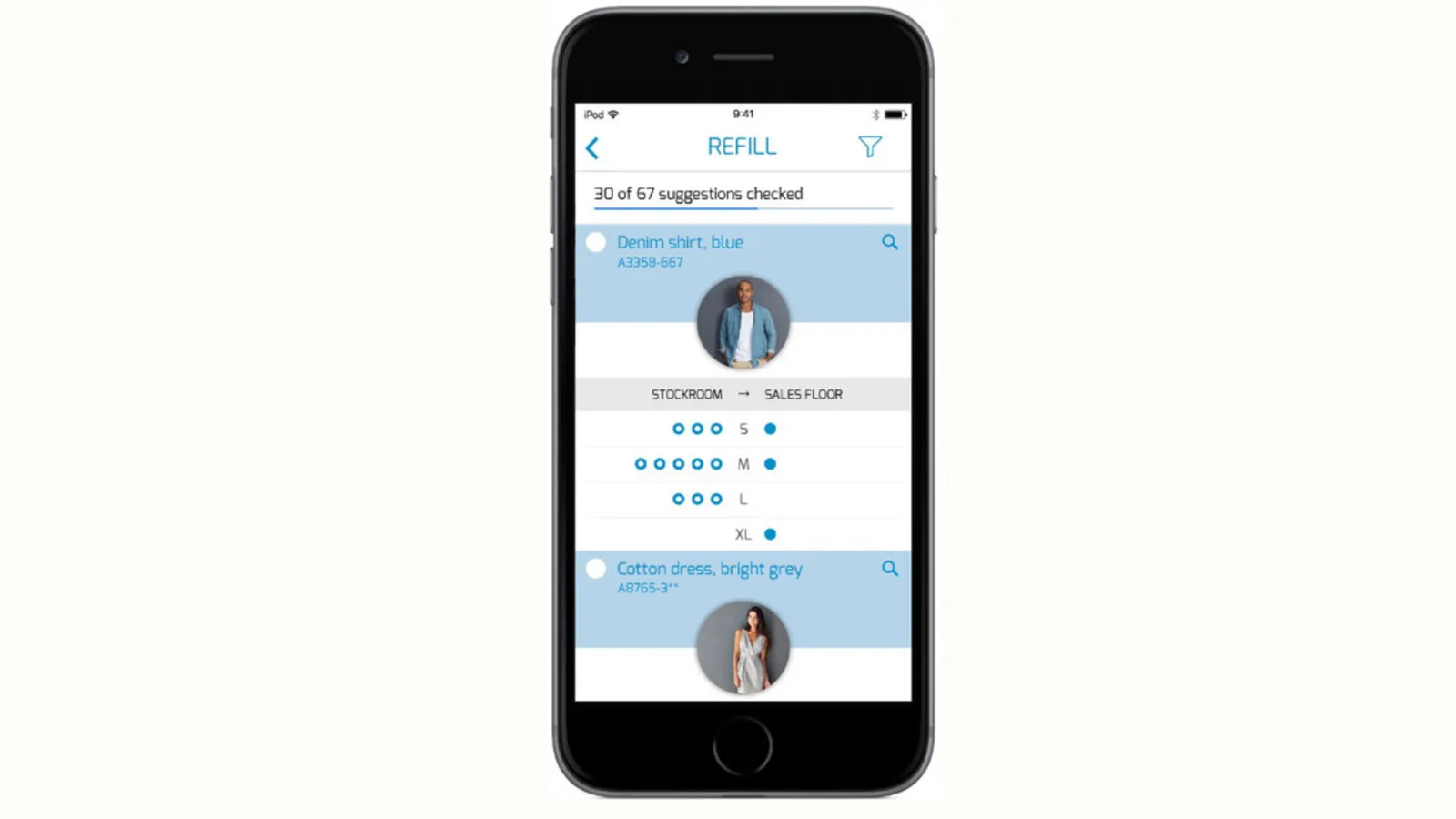
But how can machine learning be used to build a refill solution for retail stores? Based on existing and historical stock levels, algorithms can learn which product/size combinations are most important on the sales floor and which should not be there. With these insights, it is possible to produce a priority list for each store, which can be matched against RFID stock data from both the stock room and the sales floor. The results can then be presented in a prioritized ‘refill suggestions’ list.
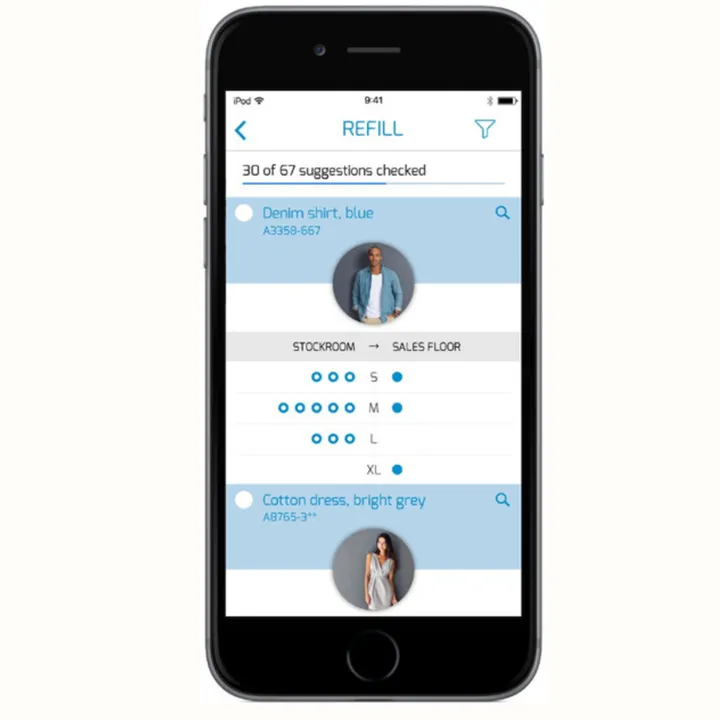
Hence, using algorithms and machine learning, refill becomes a much faster and more effective process, because store associates can be sure that the items on the ‘refill suggestions’ list are items that are a) available in the stock room and b) are (most likely) meant to be out on the sales floor. While this method can boost efficiency and effectiveness, it is important to note that a ‘human check’ is still needed of course, because machines can never take all exceptions into account.
Based on the above concept for applying machine learning, we built a refill feature fully integrated into the iD Cloud app. This app is also used for all other RFID tasks in the store, such as counting and programming new labels.
Immediately after the RFID stock per sub-location, iD Cloud presents a ‘Refill suggestions’ list, which store employees can use to decide what to refill. That means store associates now have a single view that displays both the current state of the sales floor and the stock room. To make it even clearer for store employees, pictures of the products are also included, making it possible for even a new staff member to perform refills effectively.
This methodology has been tried and tested with various apparel retailers in a significant number of stores. Based on this study, the following results were obtained:
The above results show that the ‘refill suggestions’ list is an extremely valuable tool for store employees to ensure product availability on the sales floor for their customers. This in turn leads to soft and hard benefits such as:
Having perfectly stocked shelves is one of the biggest challenges for retail stores because refilling the right items can be difficult. In this white paper, we have examined different methods to address this and concluded that refilling based on visual checks, POS transactions, and planograms leads to inefficiencies and far-from-perfect results.
One would expect a much better result with RFID-based refills, but a complete list of all differences between the sales floor and the stock room only looks great at first glance. In practice, this ‘naïve’ method also leads to an inefficient refill process because it produces very long refill lists with many irrelevant results.
Here, RFID counts combined with algorithms and machine learning deliver much more meaningful results. Of course, there is always a ‘human factor’ involved. In the end, the store employees still need to put in effort to refill. However, the first results prove that working with a prioritized ‘refill suggestions’ list delivers promising results because this refilling process is faster, the on-shelf availability is better, and even results in a sales increase due to the improved availability.
At Nedap, we help global retailers successfully adopt and scale RFID by enabling real-time stock accuracy, improving product availability across channels, and supporting smarter operations — empowering brands to enhance their processes, wherever they are in their journey.

May 19