
Nedap brings the inventory intelligence conversation to Milan. The goal: From data to action
June 8
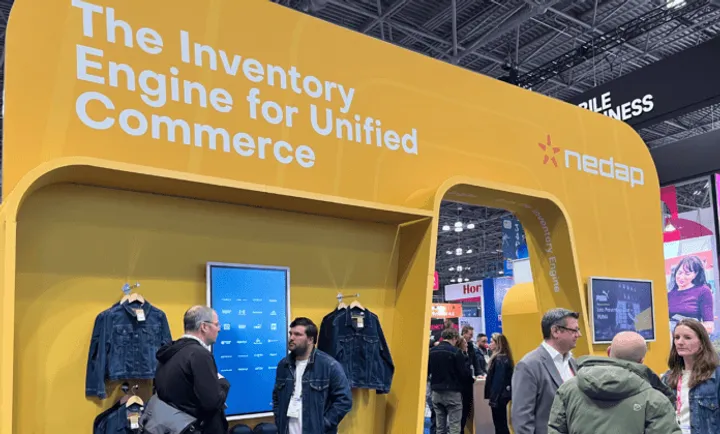
Each year, NRF sets the tone for what’s next in retail technology. The conversations coming out of NRF 2026 confirm a clear shift: retail is moving toward real-time, AI-driven, and highly interoperable ecosystems. As we look ahead to 2026, six technology trends stand out as critical for retailers and brands aiming to stay competitive.
 Tom Vieweger
Now, preparations for EuroShop are in full swing. Discussions with retailers are gaining momentum. The questions are becoming more concrete: less about experimentation, more about what actually scales. This article offers a forward-looking view on what’s taking shape in retail technology: - inventory visibility, RFID and open architectures. How retailers anticipate to this, will define who wins in the coming years.
In recent weeks, one term kept popping up again and again - specifically in keynotes, side conversations, and follow-up notes from NRF: agentic commerce. It has quickly become one of the most discussed topics in retail technology this year, so it’s worth first clarifying what it means - and then looking at the potential impact for retail.
Agentic commerce refers to a form of digital commerce in which AI-driven agents can automate shopping tasks on behalf of consumers, from product discovery and comparison to transaction execution, within defined preferences and constraints. Unlike traditional AI assistants that simply help users explore options, these agents can complete multi-step processes with minimal human involvement.
This shift moves commerce from “people using systems” to “systems acting on behalf of people.” These agents process structured inputs, navigate options, and interact with backend systems to accomplish tasks that today require manual steps. For retailers, this shift has very concrete implications: all of this only works if the data behind it is right!
Inventory information and product data must be precise, structured, and continuously up to date. Agentic commerce doesn’t tolerate ambiguity, outdated stock positions or incomplete product information. AI agents don’t improvise - they execute. Their decisions are only as good as the data they consume. For retailers, data quality stops being an operational hygiene factor and becomes a strategic prerequisite. Without a reliable, real-time foundation, agentic commerce doesn’t just underperform, it simply doesn’t work.
While new AI shopping interfaces attract most of the attention, Google quietly introduced something far more fundamental at NRF: the Universal Commerce Protocol (UCP). UCP is an open-source standard. It provides a unified, secure way for consumer interfaces to connect to commerce backends. Examples include Google’s AI Mode in Search, Gemini, and similar AI-driven interfaces. Product search, carts, checkout and fulfillment are designed to speak the same language.
UCP is not just another shopping feature; it is an architectural statement. Chatbots illustrate how shopping could work, while UCP defines how commerce must be structured to support it. As digital assistants will increasingly purchase on behalf of customers, algorithms become a new and critical target audience. For retailers, this means shifting investment away from surface-level innovation toward foundational, interoperable infrastructure.
One of the most striking insights from recent industry research, including McKinsey’s “State of Fashion 2026” report, is that inventory now ranks among the most stressed areas of retail operations, alongside pricing and sourcing costs. For fashion, footwear and sports retailers, this is existential. Margins are tight, and customers increasingly expect instant availability across channels.
Across NRF discussions, one message kept resurfacing: real-time, item-level inventory visibility is no longer a nice-to-have. It is the foundation for profitability, customer experience and effective store execution.
Retail operates in real time. Customers move, products move, and expectations shift instantly. Yet many inventory systems still show stock at rest - reconstructed manually, after the fact. This is where open standards such as EPCIS and the concept of a digital twin become critical. RFID doesn’t just count items; it creates a living digital representation of every product in the store. Instead of abstract stock numbers, each item becomes identifiable, trackable and verifiable. Shelves can be scanned in seconds. Entire stores can be counted in minutes.
Real-time availability becomes a natural outcome rather than a constant struggle. This architectural layer turns fragmented data into one trusted source of truth. When inventory data is reliable, both people and systems can act instantly - from replenishment and fulfillment to loss prevention. Modern retail rarely fails because teams don’t care. It fails when systems are fragmented. Architecture matters more than ever.
Earlier this year, I already touched on automation and overhead RFID reading in my “Fun with Inventory” article. At the time, the question was whether the industry was truly ready to move beyond manual scanning. Conversations and announcements at NRF have since made one thing very clear: this topic is not only relevant - it’s accelerating. Rising labour costs, combined with new technical capabilities, are turning automation from an efficiency ambition into an operational necessity.
For years, the RFID industry shared a common ambition: achieving accuracy and efficiency without relying entirely on manual handheld scanning. That ambition is now becoming reality.
Advances in RFID tags, reader performance and cloud-native platforms enable continuous, always-on RFID infrastructures. Stock counting no longer depends on periodic manual effort. Replenishment processes, item locationing, fitting-room analytics and shrink insights become automated and scalable.
Several use cases are maturing rapidly:
A major inflection point is approaching. Qualcomm recently announced the Dragonwing Q-6690, the first enterprise mobile processor with fully integrated RAIN RFID capabilities, and showcased it at NRF. This unlocks smaller, more efficient devices and proximity-aware experiences. And it’s only the beginning. As EU Digital Product Passport (DPP) requirements accelerate adoption, RFID will increasingly bridge enterprise and consumer worlds.
For consumers, this shift fundamentally changes how they interact with products. Easy, direct access to product data becomes possible at item level - not via QR codes or apps, but through seamless, proximity-based interaction. Consumers can verify authenticity, origin and sustainability claims instantly. Care instructions, warranty details, recalls or resale eligibility can be accessed even years after purchase. For circular use cases, such as repair, reuse or resale, the product itself becomes the carrier of its digital identity.
This also unlocks new post-purchase experiences. Think of effortless product registration, automated warranty handling, smarter returns and exchanges, or personalized after-sales services triggered by the item itself. In-store, consumer-facing RFID enables frictionless product discovery, assisted selling and availability checks without scanning barcodes or searching screens. At home, it lays the groundwork for smart inventory awareness — from wardrobe management to automated replenishment.
Today’s consumer is informed, impatient and increasingly intolerant of friction. Loyalty is fragile and must be earned continuously. In this environment, inventory accuracy and on-shelf availability stop being internal KPIs and become brand promises. Every missing item represents not just a lost sale, but lost trust.
As AI agents, open standards and always-on infrastructure converge, one thing becomes clear: Retailers who invest in visibility and architecture will win. Those who don’t will be invisible. To customers and to algorithms alike.
2026
At Nedap, we are ready to fully support the transition to fixed infrastructure. Our dedicated teams conduct technical research, building products, and supporting customers with proof-of-concepts, deployments, and rollouts.

June 8
November 28, 2025