A Wakeup Call for Finance Leaders: The Impact of Inventory Blind Spots on Retail Margins
October 2


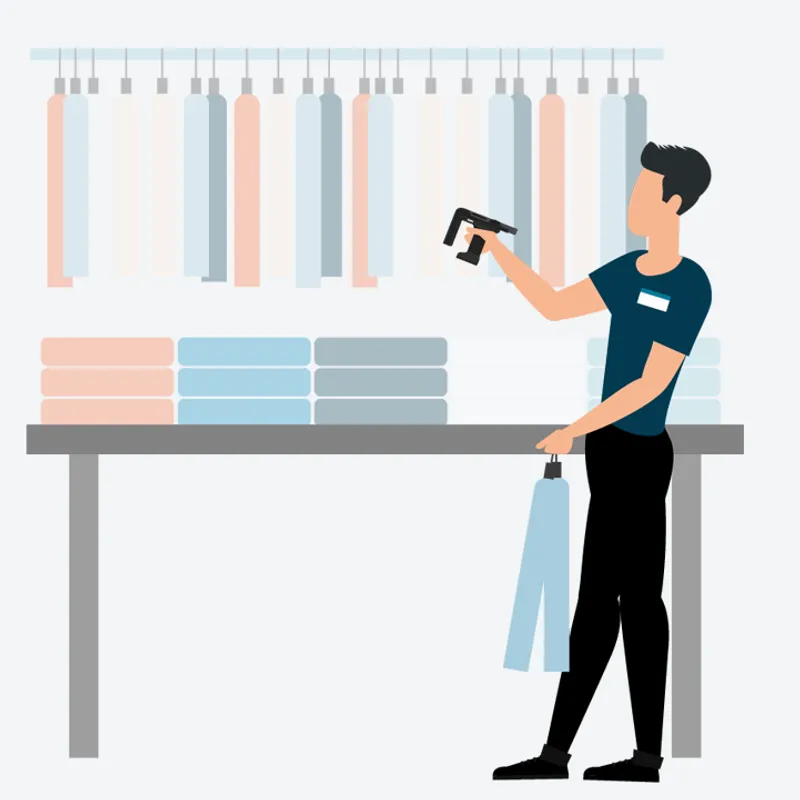
After counting your store’s stock with RFID, you finally know which items are actually there and which items aren’t. Now it’s time to put that knowledge into action.
 Harmen Koopman
After you have counted your store's stock with RFID, you finally know which items are actually there and which items aren't. If you still need to read the chapter about inventory accuracy, please read 'Chapter 1: increasing inventory accuracy' first.
Optimizing replenishing to stores and in stores ensures that more of the right products are on the sales floor, which means a 3 to even 10% uplift in sales. But how does that work?
The weekly RFID count is compared to the ERP system's stock file. Articles without an RFID label get a new one, and old RFID labels are destroyed. Also, any differences between the RFID count and the ERP stock are investigated, and proper action needs to be taken to prevent these differences in the future.
After these investigations are done, the real RFID magic comes into play. Because RFID lets you see which items should be there but aren't there, you can start working on product replenishment and on-shelf availability.
In fact, optimizing in-store product availability is the leading business case driver for starting with RFID.
Replenishment to stores and in-stores
So how do you optimize in-store product availability? There are two places to take action:
Optimizing product availability starts by getting the right products to the right stores. The ERP system often manages this DC-to-store replenishment process. If the ERP system works with accurate data provided by RFID, it can allocate better products to the right shops.
Still, these shipments are made by people. And people make mistakes. That's why it is good practice to verify incoming shipments in-store. This way, you not only speed up your process of verifying incoming shipments but also don't need to wait on the next store count to be confident on which items were actually in the box.
Once a shop has the right products, it is time to put the right products from the stock room to the sales floor. Store staff has many creative ways to refill the sales floor: manually checking which products are missing (and even video calling the employee in the stockroom to pick those products!) to daily refilling your sales floor based on inventory and sales data.
An important KPI that tracks the effectiveness of your refill process is on-shelf availability (OSA).
OSA indicates whether the most relevant sizes of articles are available for your customers on the sales floor. A high OSA indicates that products are readily available for customers to purchase. Conversely, a low OSA can result in lost sales and frustrated customers.
You need to take two steps to refill your sales floor: sublocation information and a workable refill list.
First of all, we need to know the sublocation of items. Which items are on the sales floor and in the stock room? Using RFID, you can differentiate stock on the sales floor from stock in the back of the house.
We’ve learned that RFID is great for fast and easy stock counting. Yet the power of RFID also poses a problem. Because RFID readers are so powerful, they can read through thin walls and floors, especially those used in retail stores. That means when you perform an RFID count in the stockroom, you will also read items on the sales floor and vice versa.
How can you solve this problem? There are two ways to tackle this issue: an expensive, cumbersome way and an easy, intelligent way.
Because RFID signals are blocked by metal, you can apply physical shielding like aluminum foil or metallic coating to block the RFID signals. However, physical shielding is not always 100% effective and is expensive. Physical shielding typically costs between €2000 and €4000 per store in material and labor. And even a tiny seam can cause a tag to be read through the wall. Even if applied with the highest precision, retailers often experience a 15 – 20% leakage resulting in unreliable sub-location data.
Luckily, modern technology can prevent the setting up of physical shielding. By using intelligent algorithms, you can determine the sublocation per item. The idea is simple: when doing a cycle count, select in your RFID counting app which sublocation you are counting (the sales floor or stock room). Based on the strength of the RFID signals, an algorithm knows which items are located on the sales floor or in the stock room.
Virtual shielding eliminates the need for physical shielding and allows for faster global RFID roll-outs. It also significantly increases the ROI of RFID projects and makes RFID financially feasible for more retailers.
Virtual shielding lets us know which items are located on our sales floor in the stock room. So all we have to do now is make a list of what's missing on the sales floor and start refilling.
Sound easy, right?
In reality, it's more complicated than that. Why? Because there are a lot of reasons why an item is not or should not be displayed on the sales floor. Reasons such as:
The approach of comparing the sales floor against the stock room needs to be revised. It is not enough to say that shop staff should refill any products coming up from the RFID count as being present in the stock room but missing on the sales floor. This approach would result in a long list of irrelevant results.
The answer to a workable refill list? Just like with virtual shielding, intelligent algorithms can help us here.
Based on existing and historical stock levels, algorithms can learn the most critical product-size combinations on the sales floor and which ones should not be on the sales floor. With these insights, it's possible to produce a priority list per store, which the algorithm can match with the RFID stock data from both the stock room and sales floor. The results can then be presented in a prioritized 'refill suggestions' list.
Various apparel retailers tested this methodology in their stores with substantial results:
The on-shelf availability for three core sizes improved (on average) from 88% to over 98% in a matter of weeks. An increase in on-shelf availability has been proven to result in increased sales.
Store employees spent 55% less time on refills, as they know what can be refilled and are guaranteed to find the items in stock suggested on the refill list. By removing tedious work, store employees were happier and had more time to serve customers.
We have now established the following:
With this information, can we prove the business case for RFID in fashion retail?
Yes.
In fact, the business case for RFID is based on two words: product availability.
If a product is unavailable for a customer, it leads to missed sales. But more importantly, it also causes disappointed customers, which risks losing customers in the long run. What makes it even more tragic is that the products are often in the right store, but they did not make their way out to the sales floor and are thus not easily accessible to customers.
Tackling this on-shelf availability problem is the business case driver for RFID. When retailers use RFID for their stock management and use RFID to replenish their stores better, a 3% to 4% increase in stock file accuracy correlates to a 1% increase in sales.
Based on thousands of store implementations with global retailers, we can see the following trends concerning accuracy and sales uplift:
This is the business case for RFID in fashion retail.
And yes, there are many, many aspects where RFID can increase sales and streamline processes. RFID is a great technology, and the possibilities are countless.
But, instead of doing everything at once and risking being overwhelmed, focus on improving stock accuracy, in-store refill, and DC-to-store replenishment. First, let your people familiarize themselves with RFID. Then, if you feel the foundation is strong enough, pursue the next RFID use case.
At Nedap, we help global retailers successfully adopt and scale RFID by enabling real-time stock accuracy, improving product availability across channels, and supporting smarter operations — empowering brands to enhance their processes, wherever they are in their journey.

October 2
February 21, 2025